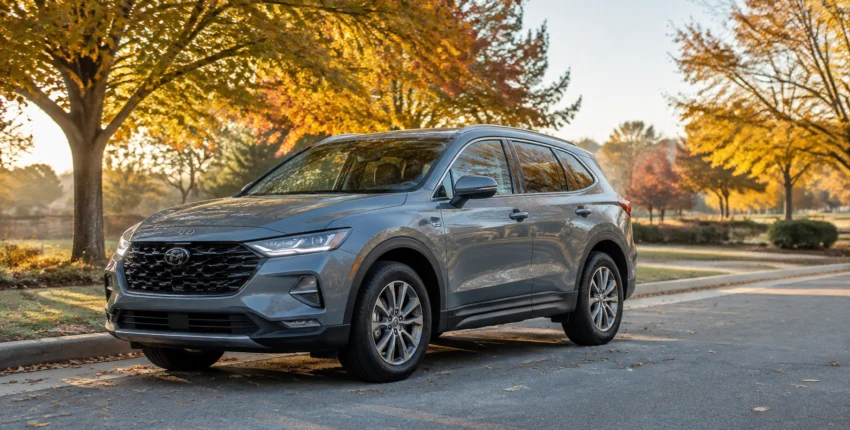
The first cool mornings of fall can bring more than changing leaves and comfortable driving temperatures. They can also bring on that small, familiar warning light on your dashboard: low tire pressure.
If your TPMS light comes on after a chilly night in Prosper, you may wonder whether you have a slow leak: or whether the weather is to blame. Often, cooler temperatures are the reason. But even when the pressure change is caused by normal physics, it still deserves your attention.
Properly inflated tires help your vehicle steer, stop, and handle as designed. They also reduce uneven wear and unnecessary fuel consumption. Here’s why tire pressure drops when the weather cools, what the warning light means, and how to keep your family’s vehicle ready for fall driving.
Why does tire pressure drop when temperatures fall?
The air inside your tires responds to temperature changes. When the weather is warm, the air molecules move more actively and create more pressure against the inside of the tire. As the temperature drops, those molecules slow down and exert less pressure.
The result is a lower PSI reading: even if the tire has no puncture.
A commonly used rule of thumb is:
Tire pressure changes by about 1 PSI for every 10°F change in temperature.
For example, imagine your tires were correctly inflated to 35 PSI on a warm 70°F afternoon. If the temperature drops to 40°F, your tires could lose roughly 3 PSI by the next cool morning. That may not sound dramatic, but it can be enough to affect handling or push a borderline tire into the underinflated range.
Organizations such as AAA and tire experts at Tire Rack recommend checking tire pressure regularly as temperatures change.
Why underinflated tires can become a safety problem
It is easy to think of a few missing PSI as a minor inconvenience. The problem is that your tires are the only part of your vehicle touching the road. Even a relatively small pressure loss changes how that contact takes place.
Handling and braking can suffer
An underinflated tire flexes more through the sidewall. That can make steering feel less precise, especially when cornering, changing lanes, or maneuvering around unexpected traffic.
Low pressure can also contribute to longer stopping distances. That matters even more when roads are wet, visibility is reduced, or you are driving with children and other passengers.
Tire wear can accelerate
When a tire is underinflated, the outer edges of the tread may carry more of the load. Over time, this can create shoulder wear and shorten the useful life of the tire.
Uneven wear may also point to other problems, such as a misalignment, worn suspension component, or tire imbalance. Correcting pressure is important, but it may not be the complete solution.
Fuel economy may decrease
Underinflated tires create more rolling resistance. Your engine has to work harder to move the vehicle, which can reduce fuel efficiency. Keeping your tires at the recommended pressure is a simple way to protect both your tires and your budget.
Heat and tire damage can build up
A low tire flexes more as it rolls. That extra flex generates heat, particularly at highway speeds. If a tire is already damaged, worn, or losing air, continued driving can increase the risk of a serious failure.
Think of tire pressure as part of your vehicle’s foundation. Ignoring it is a little like continuing to walk on a shoe with a loose sole: the problem may seem manageable at first, but it can become much more expensive and stressful later.
How to check your tire pressure correctly
Checking your tires takes only a few minutes, but the timing matters. For the most accurate reading, measure pressure when the tires are cold.
That generally means:
- Check before driving for the day.
- Or wait at least a few hours after driving.
- Avoid checking immediately after highway driving or extended trips.
Warm tires naturally show a higher pressure reading. Letting air out based on a warm reading can leave the tires underinflated once they cool down.
Use the recommended PSI: not the number on the tire
Your vehicle’s recommended cold tire pressure is usually printed on the driver’s door-jamb label or listed in the owner’s manual. Use that number rather than the maximum PSI printed on the tire sidewall.
The sidewall number is the tire’s maximum allowable pressure under specific conditions. It is not necessarily the pressure your vehicle requires.
Check all four tires, even if only one appears low. If your vehicle has a full-size spare with a TPMS sensor, check that one as well.
While checking, look for:
- A nail, screw, or other embedded object
- Cracks, bulges, or cuts in the sidewall
- Uneven tread wear
- A missing or damaged valve-stem cap
- A tire that looks noticeably lower than the others
If one tire is several PSI lower than the rest, do not assume temperature is the only cause. A slow puncture, valve leak, damaged wheel, or bead leak may be allowing air to escape.
What should you do when the TPMS light comes on?
Your Tire Pressure Monitoring System is designed to alert you when one or more tires are significantly below the vehicle manufacturer’s recommended pressure. It is a helpful safety feature, but it is not a replacement for regular pressure checks.
When the light comes on:
- Slow down and avoid sudden maneuvers.
- Check all four tires with a reliable pressure gauge.
- Inflate each tire to the recommended cold PSI.
- Drive briefly and see whether the light turns off, if your vehicle’s system resets automatically.
- Have the vehicle inspected if the light stays on or returns.
A cold snap can trigger the warning when your tires were already close to the low-pressure threshold. That does not automatically mean you have a puncture. However, the warning should never be ignored simply because the weather changed.
If the light continues to return, Qwik Oil & Auto Care can perform TPMS diagnostics to determine whether the issue is low pressure, a leaking tire, a faulty sensor, or another system problem.
A TPMS light that flashes before remaining illuminated may indicate a system or sensor fault rather than ordinary low pressure. In that situation, professional diagnosis is especially important.
When should you consider an alignment or tire inspection?
Fall is a good time to look beyond pressure. If your vehicle pulls to one side, the steering wheel sits crooked while driving straight, or the tires show uneven wear, you may need a wheel alignment.
A proper wheel alignment in Prosper can help restore steering control and reduce premature tire wear. Alignment problems can develop after hitting potholes, curbs, road debris, or rough pavement. They may also appear gradually as suspension and steering components age.
You should also consider a tire inspection if:
- The vehicle vibrates at certain speeds
- The steering wheel shakes
- One tire repeatedly loses air
- The tread is worn unevenly
- Your tires are approaching the wear indicators
- You are preparing for a long fall road trip
Pressure, balance, rotation, and alignment all work together. Maintaining one while ignoring the others can leave you with uneven wear and a shorter tire life.
How Qwik Oil & Auto Care helps prepare your vehicle for fall

At Qwik Oil & Auto Care, our tire services are designed to help you handle seasonal changes with confidence. Our ASE-certified technicians can help with:
- Tire pressure checks and adjustments
- Tire rotations
- Tire balancing
- Flat tire repair
- New tire sales and installation
- Wheel alignments
- Tire safety inspections
- TPMS diagnostics and service
We offer tires from trusted brands, including Michelin, Continental, and Nitto, and we service all makes and models: including domestic vehicles, imports, SUVs, trucks, and exotics.
A fall tire visit can be simple: we check the pressure, inspect the tread and sidewalls, look for leaks, and evaluate whether your tires are wearing evenly. If an alignment or TPMS issue is contributing to the problem, we can explain what we found and discuss practical next steps.
That honest, transparent approach is important. You should understand what your vehicle needs, why it needs it, and what may happen if the issue is left alone.
Make tire pressure part of your fall routine
Cooler weather does not automatically mean your tires are failing. In many cases, it simply means the air inside them has contracted. Still, a pressure drop of about 1 PSI for every 10°F can affect safety, handling, tire wear, and fuel economy.
Check your tire pressure when the tires are cold, use the PSI listed on your driver’s door, and take every TPMS warning seriously. If a tire keeps losing air or your vehicle does not feel right, have it inspected before a small issue becomes a roadside emergency.
For dependable tire care in Prosper, visit Qwik Oil & Auto Care’s tire and alignment service page or book an appointment online. A few minutes of preventive care now can help protect your tires, your vehicle, and the people riding with you this fall.