
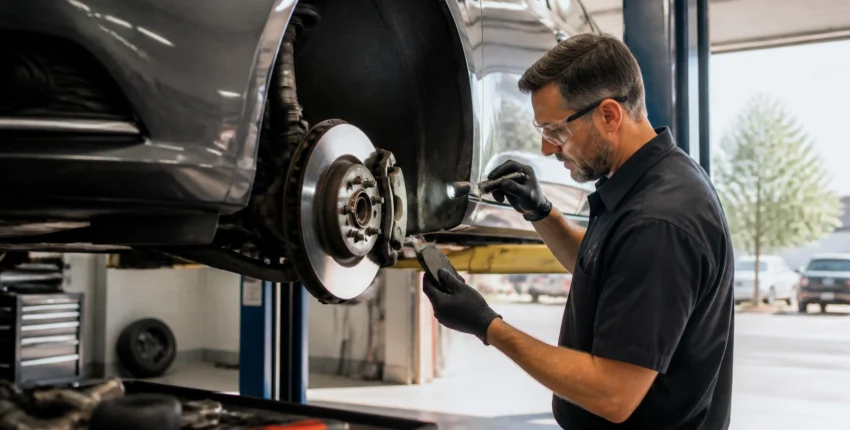
You hear a squeal every time you slow down in Prosper, TX. Or maybe the brake pedal feels slightly different, the car pulls to one side, or you notice a rough grinding sound coming from a wheel.
The next question is usually, “Do I need new brake pads, or can a mechanic just adjust something?”
That is a reasonable question. Brake repairs can range from a simple adjustment or hardware service to replacing pads, rotors, brake fluid, or other components. The challenge is knowing which situation applies to your vehicle without guessing: and waiting too long can turn a relatively affordable repair into a much more expensive one.
Here is the truth: a brake adjustment may solve certain problems, but it cannot restore friction material that has worn away. A proper inspection is the best way to determine what your vehicle needs and what it does not.
If you are searching for brake repair near me or a trusted mechanic in Prosper, TX, this guide will help you understand the difference.
What Does a Brake “Adjustment” Actually Mean?
The word “adjustment” can mean different things depending on the vehicle and the symptom.
Modern disc brake systems are generally self-adjusting as the pads wear. If the friction material is too thin, adjusting the brakes will not make the pads safe again. They need to be replaced, usually on both sides of the same axle so braking remains balanced.
However, an adjustment or related service may be appropriate in situations such as:
- A parking brake that feels too loose
- Rear drum brakes that need their shoes adjusted
- Brake hardware that is sticking or not moving correctly
- A caliper or slide pin that needs cleaning and lubrication
- Brake pads that are rattling because clips or shims are worn
- A pedal concern caused by air, contaminated fluid, or another hydraulic issue
Think of it like a pair of worn-out shoes. Tightening the laces may improve the fit, but it will not replace a missing sole. If the brake pad material is gone, the correct solution is replacement: not an adjustment.
Squealing Brakes: Do You Need New Pads?
A high-pitched squeal is one of the most common reasons drivers look for brake repair in Prosper. Sometimes it is a warning that the pads are approaching the end of their usable life. Many brake pads include a small metal wear indicator designed to produce a squealing sound when the friction material becomes thin.
But squealing does not always mean the pads are completely worn out.
Temporary noise can occur after rain, car washing, or overnight moisture. Light surface rust on the rotor may make noise during the first few stops and then disappear. Brake dust, glazed pad material, aftermarket components, or a sticking caliper can also create squeaks.
When squealing deserves attention
Schedule a professional brake inspection if the noise:
- Happens repeatedly whenever you brake
- Continues after several normal stops
- Is getting louder or more frequent
- Appears along with vibration, pulling, or a soft pedal
- Comes from one wheel rather than all four
A technician can measure the pad material, inspect the rotor surface, check the caliper and hardware, and determine whether the noise requires replacement or a smaller repair.
Do not rely on sound alone. Some vehicles do not have wear indicators, and a quiet brake system can still have dangerously thin pads.
Grinding or Grating Usually Means “Do Not Wait”
A deep grinding, scraping, or grating sound is more serious than a light squeal. It can mean the friction material has worn away and the metal backing plate is contacting the rotor.
Once metal touches metal, damage can happen quickly. The rotor may develop deep grooves, excessive heat, or thickness problems. In some cases, the caliper can also be affected. What might have been a pad replacement can become a pad-and-rotor repair, with additional parts needed to restore safe braking.
If your brakes are grinding:
- Avoid unnecessary driving.
- Do not assume the noise will go away.
- Arrange a brake inspection as soon as possible.
- If braking performance is severely reduced, have the vehicle towed rather than driving it.
Brake noise is your vehicle’s way of asking for attention. Ignoring it is similar to ignoring a warning light on a smoke detector because the alarm is inconvenient. The problem rarely improves by itself.
Brake Pad Thickness: The Measurement That Matters
Brake pads wear down gradually with normal driving. City traffic, frequent stop-and-go driving, heavy loads, towing, and riding the brake pedal can accelerate wear. There is no universal mileage interval that applies to every car, driver, or driving route.
A new disc brake pad may have roughly 10–12 millimeters of friction material, although specifications vary. As a general guide:
- Around 7 mm or more: Usually healthy, but the pads should still be monitored during routine service.
- About 5–6 mm: Wear is becoming noticeable; plan follow-up inspections.
- Around 3–4 mm: Replacement is commonly recommended soon, depending on the manufacturer’s specifications and your driving habits.
- Near 2–3 mm: The pads are at a critical level and should not be postponed.
- Less than 2 mm: Driving may be unsafe, with a high risk of rotor damage.
The measurement refers to the friction material only: not the metal backing plate. It is also important to check both the inner and outer pads. Uneven wear can point to a sticking caliper, seized slide pin, damaged hardware, or another issue that a simple pad replacement may not correct.
A quick look through the wheel spokes can provide a rough idea of pad thickness, but it is not a complete inspection. The inner pad may be wearing differently, and the wheel may need to be removed for an accurate measurement.

Do Worn Brake Pads Always Mean Worn Rotors?
Not necessarily. If the pads are replaced before they reach the backing plate, the rotors may still be within specification. But the rotor must be checked rather than assumed to be reusable.
A professional inspection typically considers:
Rotor surface condition
Deep grooves, cracks, heavy rust, blue or dark heat spots, and uneven wear may indicate that the rotor needs resurfacing or replacement. Resurfacing is not appropriate for every rotor, especially when the disc is already near its minimum thickness.
Rotor thickness
Rotors have a minimum thickness specification. If a rotor is too thin, it cannot safely dissipate heat or provide the correct braking surface. A measurement with the proper tool is more reliable than judging the rotor by appearance.
Runout and braking vibration
A steering-wheel shake or pedal pulsation during braking can be related to rotor thickness variation, runout, uneven deposits, suspension components, or wheel installation issues. The cause needs to be identified before parts are replaced.
Caliper and hardware condition
A sticking caliper or damaged slide hardware can cause one pad to wear faster than the other. Replacing pads without addressing the cause may lead to repeat noise, uneven wear, or premature failure.
Qwik Oil & Auto Care provides brake pad and rotor replacement along with inspections of the related components, helping you understand whether replacement, adjustment, or another repair is appropriate.
Do Not Overlook Brake Fluid
Brake pads and rotors receive most of the attention, but brake fluid is equally important to how your vehicle stops.
Brake fluid transfers pressure from the pedal to the calipers or wheel cylinders. If the fluid is low, contaminated, or affected by a leak, you may notice:
- A soft or spongy brake pedal
- A pedal that sinks farther than usual
- Reduced braking response
- Visible fluid around a wheel, hose, line, or master cylinder
- An illuminated brake or ABS warning light
Low brake fluid is not always a maintenance issue. It can be a sign of worn pads or a leak in the hydraulic system. Simply adding fluid without finding the reason for the low level can leave a serious problem unresolved.
As part of a brake service, Qwik Oil & Auto Care can inspect the hydraulic system and provide brake fluid exchange service when appropriate. The correct service interval depends on your vehicle, fluid condition, and manufacturer recommendations.
When You Should Book a Professional Brake Inspection
You should have your brakes inspected promptly if you notice:
- Persistent squealing, scraping, or grinding
- Longer stopping distances
- A soft, low, or inconsistent brake pedal
- Vibration or pulsation while braking
- Pulling to the left or right
- An ABS or brake warning light
- Uneven pad wear
- A burning smell near a wheel
- Brake fluid that is low or visibly leaking
A professional inspection protects you from two common mistakes: replacing parts you do not need and postponing a repair that has already become unsafe.
At Qwik Oil & Auto Care in Prosper, our ASE-certified technicians service all makes and models, including exotics. We provide honest, transparent recommendations and competitive pricing, so you can make an informed decision based on the condition of your vehicle: not pressure.
The Bottom Line for Drivers in Prosper, TX
So, do you need new brake pads or just an adjustment? If your pads are worn, an adjustment will not solve the problem. If the issue involves loose parking-brake operation, sticking hardware, drum-brake adjustment, or another correctable concern, a smaller service may be all that is needed.
The only dependable way to know is with a complete brake inspection that considers pad thickness, rotor condition, caliper operation, brake fluid, and the overall hydraulic system.
Your brakes are not the place to gamble. Regular inspection is an investment in safer driving, fewer surprises, and potentially lower repair costs. For reliable auto repair in Prosper, TX, contact Qwik Oil & Auto Care or book an appointment online. Our team is ready to help you stop safely and drive with confidence, backed by nationwide warranty coverage.